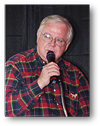
Born a Preacher's son, John started out singing in his father’s church as a very small child. "Singing in Church is like karaoke, the words come up on screens or you read them from your hymn book, just like karaoke, right?"
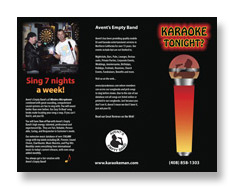
 John picked up on the Karaoke phenomenon back in the late 80's, when the music was still on laser disks, he has been hooked ever since...so hooked that by the mid 1990's he founded Avent's Empty Band. John became "Karaokeman" at The Office Bar in Sunnyvale, Ca. Since then Avent's Empty Band has hosted more shows in the San Francisco Bay Area than any other karaoke company to date! John picked up on the Karaoke phenomenon back in the late 80's, when the music was still on laser disks, he has been hooked ever since...so hooked that by the mid 1990's he founded Avent's Empty Band. John became "Karaokeman" at The Office Bar in Sunnyvale, Ca. Since then Avent's Empty Band has hosted more shows in the San Francisco Bay Area than any other karaoke company to date!
John wants you to know what karaoke can do for you...
 |
Fulfills you |
|
Gives you a sense of camaraderie |
|
Uplifts your spirit |
|
Promotes self confidence |
|
Lets you escape the drudge of everyday life |
|
Allows you to enjoy yourself, be happy and have fun |
|
Make new friends or in some cases find love |
|
Gives you a sense of achievement |
|
Helps you pull your life together |
|
Gives you a sense of community, belonging |
|
Helps local small business |
"Karaoke has a way of spilling out into other parts of your life
and improving your overall chances of success!"
    
See Show Listings Join our mailing list
|
Definition of "Karaoke"
Karaoke (Japanese: from kara, "empty", and ôkesutora, "orchestra") is a form of entertainment where recorded music accompanies an amateur singer who sings along with the accompaniment on microphone. The music is of a well-known song in which the voice of the original singer is absent or reduced in volume. Lyrics are usually also displayed, sometimes including color changes synchronized with the music, on
music video to help with the sing-along. Karaoke has been a popular form of entertainment in East Asia since at least the 1980s, and has since spread to other parts of the world. Karaoke engenders quite a bit of culture specific to its enthusiasts, and this culture, unsurprisingly, varies from country to country. Much of the information in this entry is currently specific to karaoke's area of origin in the Far East.
Word origin:
The Japanese word stems from the words kara, meaning "empty" (as in karate, "empty hand") and oke which is short for ôkesutora, meaning "orchestra". The words together make a contraction literally meaning "empty orchestra". It used to be a slang in media where a live performance is substituted by a prerecorded music and thus it is written in katakana. The term karaoke can be interpreted as "virtual orchestra" because one can specify a key to the music and start singing along without the presence of a live band or orchestra. In the United States, the word is often pronounced as "karioki". The Japanese
pronunciation is "karaoke".
|